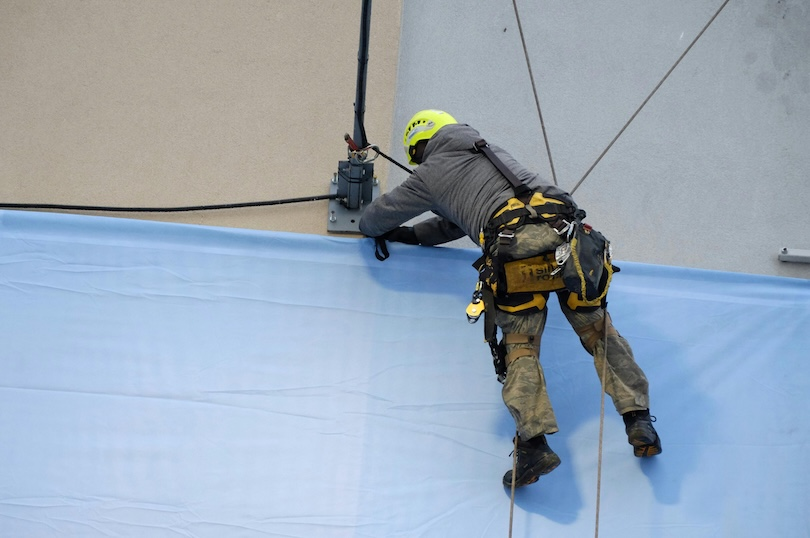
Our today toolbox talk is about Life Saving Rules, and more precisely about Working at Height, still one of the main leading factors in regards to fatalities occurrence in the offshore oil and gas industry, but not only limited to it.
If you didn’t worked in the oil and gas industry, probably you might not be very familiar with the terminology of the Life Saving Rules which has been initiated by the International Association of Oil and Gas Producers, and has been gradually adopted and developed by each company, being used as non-negotiable set of “golden” rules for keeping the level of safety to an appropiate level.
Working at Height
What is working at height, the definition?
In most of the companies working at height is defined as the risk of falling from a height of 1.5, 1.8, 2 meters, from where if precautions are not taken, personal injury can occur.
From my point of view a correct definition of working at height can be: any task performed where a person could fall and be injured.
What the are the hazards associated with Working at Heights?
The most obvious and serious hazard is falling from an elevated position.
Falls may occur from:
- Scaffoldings
- Ladders
- Platforms
- MEWPs
- Crane baskets
- Structural steel or pipe racks
- Open edges without guardrails
- Open hatches/ gratings
Common causes that lead to falls from working at heights:
- No fall protection in place
- Incorrect use of fall protection equipment or poor condition of equipment
- Slipping or losing balance
- Overreaching/ climbing over the handrails or protected edges
Even a fall from 2-3 meters can cause fatal injuries.
Life Saving Rule – Working at Height – What is telling to us
Very simple and strand forward and if we follow all this points, working at height should be much safer:
PROTECT YOURSELF AGAINST A FALL WHILE WORKING AT HEIGHT:
- Inspect my fall protection equipment before use
- I secure tools and work materials to prevent dropped objects
- I tie off 100% to approved anchor points while outside of protected areas

What you have to do as a SUPERVISOR?
- I ensure a fall protection plan is in place that identifies fall protection equipment including fall restraint, fall arrest, approved anchor points and a rescue plan
- I ensure workers are competent to use fall protection equipment
- I ensure a correct permit to work is in place and a specific job safety analysis has been done to cover all the tasks to be performed
- I ensure workers have understood their responsibilities in regards of the task
What you have to do as a WORKER?
- I have the required training and knowledge to safely perform work
- I ensure that safe guards, barriers or safety nets are in place
- I ensure that anchor points and fall protection equipment are inspected and in good condition prior to use
- I use only approved anchor points
- I verify that clearances below the work area are sufficient if an arrested fall occurs
- I secure hand tools and work materials to prevent dropped objects
- I am always tied off when at height outside a protected area
What is a “Protected Area”?
Protected areas may include stairs with handrails, man lifts and approved scaffolds
What is an “Approved Anchor Point”?
Approved anchor points are those that are capable of safely withstanding the potential impact forces applied and meet or exceed any other applicable regulatory requirements.
What is “100% Tie Off”?
Being secured at all the time at least in one approved anchor point while working at height. This can be ensured by the use of a full body safety harness provided with 2 lanyards. Also it can be done by using and Self Retractable Lifeline.
Non-exhaustive Safety Controls That Can be Considered for Working at Height
Below is presented a non-exhaustive set of controls that can be considered by you prior working at height in order to minimise the risks:
Permit to Work
Any task should start with a valid Permit to Work (PTW) that must be approved by the authorised person/ department leader/ HSE Officer.
Risk Assessment/ JSA
The permit to work must be endorsed by a specific Job Safety Analysis or Risk Assessment in order to identify:
- Fall hazards
- Dropped object hazards
- Access and egress routes
- Rescue procedures
- Step by step task description
The JSA or RA shall integrate the required controls, responsible for actions, any other involved work groups.
Equipment Inspection
All equipment used for the task must be inspected before use, this is referring to the personal fall protection equipment and also the working equipment used to perform the task:
- Full body safety harness
- Double hook lanyards
- Anchor points
- Lifelines
- Scaffolding
- Ladders
Damaged equipment must never be used. Prior and After use equipment inspection it is essential.
Personal Protective Equipment
When working at height, the following PPE may be required based on the Risk Assessment or JSA outcomes:
- Full body safety harness
- Double lanyard with shock absorber
- Safety helmet with chin strap
- Non-slip safety footwear
- Suitable type of gloves
When deciding what type of safety harness will be used for the task, always must be considered the fall factor.
Maintaining 100% Tie-Off
When exposed to a fall hazard, workers must maintain 100% tie-off at all times.
This means that you MUST:
- Always being connected to a secure anchor point
- Using double lanyards when moving from one point to the other
- Never disconnecting both hooks simultaneously
There must never be a moment without fall protection.
Safe Use of Ladders
Ladders are commonly used in our daily tasks, and many times are not perceived as a hazardous task, however a person falling from a ladder can sustain severe injuries. Following aspects should be considered:
- Inspect the ladder before use
- Ensure it is secure and stable
- Maintain three points of contact
- Do not carry tools while climbing
- Do not stand on the top step
Always maintain the correct 4:1 ladder angle.
Dropped Object Prevention
Still falling – Still Killing. When working at height, it is essential to prevent objects from falling.
Controls include:
- Securing tools with tethering lanyards
- Using certified tool bags
- Installing toe boards
- Barricading the area below
- Maintaining good housekeeping
- Use drops matts where required
Even a small object, as a coin, falling from height can cause serious injury. This we will cover in a different tool box talk.
Weather and Environmental Conditions
Most of the companies they have in place a working at height procedure/ policy, where weather limits are included, for working at height. Work at height should stop immediately if:
- Strong winds develop
- Surfaces become slippery
- Lightning is present
- Visibility becomes poor
- Vessel rolling
Environmental conditions must always be assessed and discussed before starting the job. Officers on bridge, on board of the vessels must permanently monitor the weather and inform the work groups involved.
Emergency and Rescue Plan
Before starting working at height, a rescue plan must be developed and the emergency response team must know:
- How a fallen worker will be rescued
- Where rescue equipment is located
- Who is responsible for the rescue
Suspended workers must be rescued quickly to prevent suspension trauma.
Suspension trauma straps equipment should be part of the fall protection equipment.
Rescue drills for working at height should be included in the annual drill plan.
Stop Work Authority
It is the right and the responsibility of every person to intervene and to stop work if conditions become unsafe.
Intervene and Stop the job if:
- Fall protection is missing
- Equipment is damaged
- Anchor points are unsafe
- Weather conditions change
Safety always takes priority over production, and should always be like this.
Important
The toolbox talks must be always a dialog and not a monolog. You need to be sure that all your team has a clear understanding of the discussed topics. ALWAYS ASK FOR FEEDBACK – THIS WILL HELP and WILL PROVIDE VALUABLE INPUTS!
Leave a Reply